Washi: Sumi-e paper
Direct Sales: Sumi-e Gallery
Art under 1000€ Portrait/CV
Taking sumi-e to the next level: From 2D to 3D
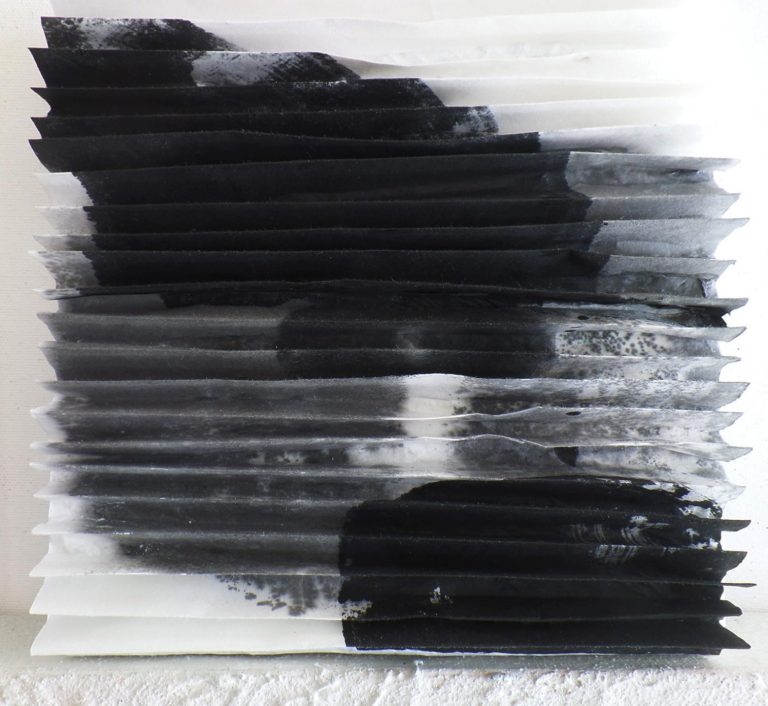
Sumi-e works are typically created as two-dimensional pieces on Japanese washi paper. However, there is another approach: transitioning from 2D to 3D. This opens up new possibilities for this traditional painting technique and its forms of expression. One such possibility is sumi-e in the leporello style, featuring a zigzag fold that gives it a three-dimensional quality.
The potential applications of washi paper are truly diverse. As well as being used in traditional Japanese and Chinese arts such as calligraphy and ink painting, it is also used in modern applications that would have been unimaginable 200 years ago, including paper bookmarks, memo pads, lampshades, and components of clothing and shoes.
Washi paper is a natural material made from mulberry bush fibres, characterised by its strength and durability. It is said to be able to withstand preservation for over 1,000 years. Indeed, Japanese washi paper books dating back to around 1000 AD still exist today.
When creating my own modern ink paintings, I wanted to explore the characteristics of both washi paper and traditional ink painting. Initially, I tried the well-known Japanese origami folding technique, but ultimately found it unsatisfying artistically. Switching to the leporello style was the answer.
Since the artwork is monochrome, folding it to create a three-dimensional zigzag form produces unique light and shadow effects depending on the viewing angle. This creates a fascinating texture and visual impact that differs from the flat version.
I have begun to explore the world of traditional Japanese paper in a new way.
A UNESCO Intangible Cultural Heritage
The first characteristic of washi is its durability and strength. In Japan, there are still surviving books written in 1000 AD.
At the Louvre Museum, a drawing by Leonardo da Vinci was severely damaged; the drawing, on 500-year-old paper, had become as fragile as a withered leaf. After extensive discussions on restoration, including European parchment restoration techniques, the final solution was to reinforce the drawing from the back with extremely thin paper. A type of Japanese washi called "Tengu Choshi", even thinner than ordinary washi, was selected.
Furthermore, as seen in Kyoto fans, washi is a flexible material and can be folded quite freely. It is less prone to damage even with frequent folding, making it a valuable and long-lasting material.
Direct Sales: Sumi-e Gallery
Art under 1000€ Portrait/CV